AI Marketing Tools: What Actually Works for Agencies in 2026
Share now

The Problem With Most AI Marketing Tools
Let's be honest about where we've been.
For the past two years, AI marketing tools have promised to write code, automate work, and replace hours of manual labor. In practice, results were inconsistent.
You'd get code that needed heavy cleanup, duplicated logic across workflows, frequent hallucinations, and inconsistent patterns from one output to the next.
To make that output usable, you had to build rules, create standards, and babysit every step. You were still effectively programming manually, just with a different interface.
Most agencies are still stuck in iteration instead of transformation. They've adopted AI marketing tools but haven't fundamentally changed how work gets done. The tools assist, but they don't contribute.
What Changed on February 5, 2026
When Fernando tested the new models, something shifted.
The quality jump was real. Not perfect, but meaningfully better. And it revealed something important: the engineering barrier isn't the bottleneck anymore.
You can now build fully functional systems in a weekend using modern AI workflows. What used to take weeks of engineering now takes hours with the right orchestration.
That kills the old bottlenecks. Writing code, API stitching, and deployment overhead are no longer the things slowing agencies down. The bottleneck has moved to strategic understanding, clarity about what you're solving, and scope and business design.
When anyone can generate working code in hours, coding stops being an advantage. Understanding value becomes an advantage. For agencies, this is a fundamental shift.
The question is no longer "can we build this?" It's "do we know what to build and why?"
The New Bottleneck: Domain Knowledge and Structured Data
With AI marketing tools generating code and content faster than ever, two things separate good outputs from transformational ones: domain expertise and structured data.
Domain expertise means understanding a market at a deep level. Its problems, patterns, pain points, and dynamics. Anyone can generate an app. But only someone who truly understands the business can generate the right inputs, constraints, context, and interpretations.
Structured data means organizing your company's knowledge so AI can reason with it. Today's AI marketing tools can connect to CRMs, Google Ads, analytics dashboards, and reporting platforms.
The problem is that that's just surface context. The real challenge is structuring your entire organizational knowledge, such as historical campaigns, client interactions over years, and even internal strategy decisions and recurring bottlenecks. All of it needs to be connected and accessible.
Without this structure, AI becomes fragmented. It sees pieces, not the whole story. And that's why most agencies fall short. They have data silos instead of insights backbones.
How Agencies Are Approaching This: AI Marketing Tools Compared
We've tested several AI marketing tools that attempt to solve this problem. Here's what we've found.
OpenClaw
OpenClaw offers persistent memory AI that can access your data and maintain context across sessions. It's been getting buzz as a breakthrough in AI continuity.
Pros:
- Persistent memory is a genuine step forward from session-based AI
- Can connect to external data sources
- Works autonomously across tasks
Cons:
- Goes broad and shallow, looking externally for data rather than building deep context
- Security risks are significant; we're currently setting up a device and having a hard time closing down all the vulnerabilities
- Less controlled environment means less predictable outputs
- Not siloed by client, which creates context bleed
OpenClaw seems like promising technology, but most of the current implementations trade safety for speed: exposed instances, weak authentication, and broad system permissions have already led to real data leaks and compromise scenarios, which is a non‑starter in agency environments where you’re sitting on client ad accounts, CRMs, and private Slack/email archives.
On top of that, the way it ingests untrusted web content and messages into a single, high‑privilege agent with shallow, loosely governed context makes prompt‑injection and “oops, it just did that” failures far more likely than in a tightly scoped, audited internal stack—so for agencies, it’s better treated as a lab toy in a sandbox than something you point at live client data.
Repli
Repli centralizes your data and lets you trigger workflows from a unified dashboard. It's designed to bring everything into one place where you can see, manage, and execute.
Pros:
- Good job of pulling data into a central location
- Clean interface for visibility
- Helps teams understand what's happening across workflows
Cons:
- Still requires human triggers at every step
- You have to grab data, bring it here, do this, then do that; the human element remains
- Not built for autonomous execution
- No deep context per client
Repli is a solid tool for where most agencies are today: listening for simple CRM events and firing pre‑defined playbooks. But the real use in AI ops comes from not needing triggers. The next generation of systems constantly watches meetings, Slack, and performance data, builds its own memory, and decides what matters without you hard‑coding every “if X then Y,” so agents behave less like macros and more like operators that proactively spot issues (slipping QA, rising CPL, silent clients) and fix them before you even think to pull a trigger.
The Gap in Current AI Marketing Tools
Across the tools we tested, the pattern is consistent. They’re either broad and shallow, like OpenClaw, which can wire itself into lots of surfaces but has fragile, hard‑to‑govern context when you’re dealing with long‑running, high‑stakes workflows, or centralized but fundamentally manual, like Repli‑style “if this, then that” automation, where humans still have to define every trigger, rule, and edge case.
None of them solve the core problem for serious agencies: building deep, account‑specific context for each client so AI can reason like a strategist who actually knows the history, constraints, and goals of that account, instead of acting like a clever macro glued to your CRM.
That’s the gap we built Brain to close, an internal layer that builds and maintains rich, siloed context per client so agents make decisions with the same nuance your best operator would, not just react to surface‑level events.
What We Built: Introducing Brain
Brain isn't another AI marketing tool. It's a knowledge infrastructure.
Why We Built It
At 8F, we have 20+ years of agency consulting experience and insights from working with 1,000+ marketing agencies. We knew early that the advantage wouldn't be in tools. It would be in knowledge architecture.
The teams we work with kept telling us the same thing: "When it works, it's great. But I still have to grab this, bring it here, do this, then do that." Every process included too many human checkpoints and too much manual orchestration.
We built Brain to take away that human element and let AI run through entire processes, start to finish, in a reasonable way.
What Brain Actually Is
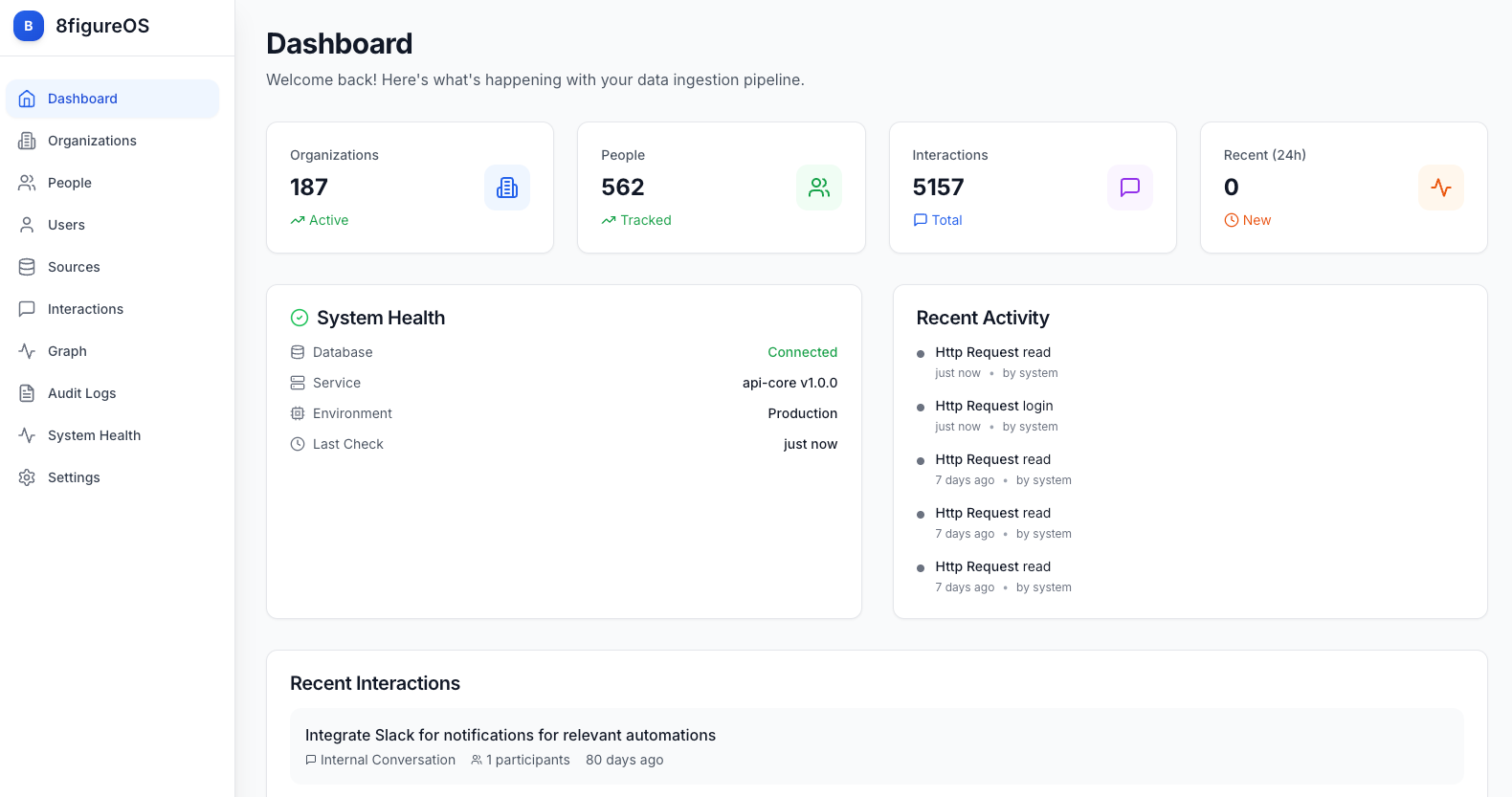
Brain is a multi-level ingestion center that pulls all your data from Slack and email communications, meeting transcripts, SOPs and best practices documentation, CRM systems, historical campaign data, and client interactions. Everything gets stored in a centralized data warehouse.
But here's the key difference: instead of going broad and shallow like other AI marketing tools, Brain goes deep.
Each client gets their own siloed context. Think of it like having a strategist who knows that client extremely well. Their history, their voice, their patterns, their preferences. Brain creates that same depth, but in a managed data environment.
How It Works Differently
While tools like OpenClaw look externally and pull from everywhere, Brain builds deep wells of context for each client. The AI isn't guessing or generalizing. It's reasoning with structured, specific knowledge.
With Brain, all data stays in a controlled data center. There are no security risks from external access and no context bleeds between clients.
Besides remembering, Brain also organizes your work. For example, historical campaigns connect to outcomes, while client interactions link to strategy decisions. The AI sees the whole story instead of just fragments.
Because Brain has deep client context, it can speak in that client's voice, reflect on past work, and make decisions that align with their specific situation.
Where We're Going With It
Here's what got our attention: when Opus 4.6 came out, autonomous AI jumped from 7 hours to 2 weeks of continuous operation. It built its own hierarchy across 18 different agents and communicated back and forth in real time as they coded.
The experts predicted we'd jump from 7 autonomous hours to maybe 8 by end of April. Instead, we jumped to 2 weeks.
We're building Brain to be ready for this future. Very soon, AI won't need triggers because it will trigger on its own. What we'll need is the ability to QA on the back end. And that requires rich, structured context that AI can reason with autonomously.
Brain is that foundation. It's designed so that as autonomous AI becomes more affordable, agencies can run agentic workflows immediately without having to go back and rebuild their infrastructure.
What This Means For You
AI marketing tools have already changed agencies. The real challenge is the question is whether you're structured to take advantage of it.
If your data lives in silos, if your AI tools are broad and shallow, if every workflow still requires human triggers, you're building on shifting sand. The agencies that win in this next phase will be the ones with deep domain knowledge, structured and centralized data, and infrastructure ready for autonomous AI.
In other words, the next big bottleneck for marketing agencies is knowledge architecture.
See Where You Stand
We built the Agency AI Diagnostic to help you understand exactly where you are and what it will take to become an agentic agency.
Because in a world where AI marketing tools can do the work, only those who lead with structured insight will win.
This is paragraph text. Click it or hit the Manage Text button to change the font, color, size, format, and more. To set up site-wide paragraph and title styles, go to Site Theme.
Recent Post